
Opening
The story of going abroad is usually told like this: domestic growth has peaked and overseas is the next goldmine. Anyone who has done it knows the arithmetic does not work that way — ByteDance started building overseas in 2016, and ten years on TikTok is still the best result any Chinese brand has achieved abroad, with a clear gap to Douyin on monetisation; BYD's overseas brand strength also took years of investment to take shape. Differences of context and the long cycle of operating locally are two barriers nobody avoids, and this article passes over them in a sentence. The one worth calculating is the third: national image. It is unremarkable in normal times, but the moment a brand slips it decides how far that mistake is amplified. Temu's low prices were forgotten quickly, while a "cheap and nasty" label, once it sticks, is amplified again and again.
Overseas views of China really have moved over the past two years, and there are two ways to see it. One is the survey work Pew, Gallup and others run every year across dozens of countries, which measures what ordinary people say when they are asked. The other is what users in overseas communities such as Reddit write of their own accord every day, which measures what they actually talk about and how they feel while doing it. This article sets out both, then says what they mean for a Chinese brand going abroad: for the first time, technical respect is an asset Chinese brands can actively draw on.
1. The international surveys: most countries now view China more favourably than the US
Start with the most direct set of facts — how people in each country answer when they are asked whether they view a country favourably. Three independent surveys, all verified:
- Pew (July 2026, a 36-country survey): most countries now view China more favourably than the United States, with only 6 significantly the other way. Canada is the clearest case: favourability toward the US fell from 57% in 2023 to 33%, while favourability toward China rose from 14% to 44%, the two lines crossing after levelling in 2025 (verified word for word against Pew).
- Pew (April 2026, the United States): 27% of Americans view China favourably, up 6 points on the year and close to double the 14% of 2023.
- DPI 2026 (the Alliance of Democracies Foundation, as reported by bne IntelliNews): global perception of the United States has fallen behind both China and Russia for the first time.
Pew's chart 1: the 36-country dot plot
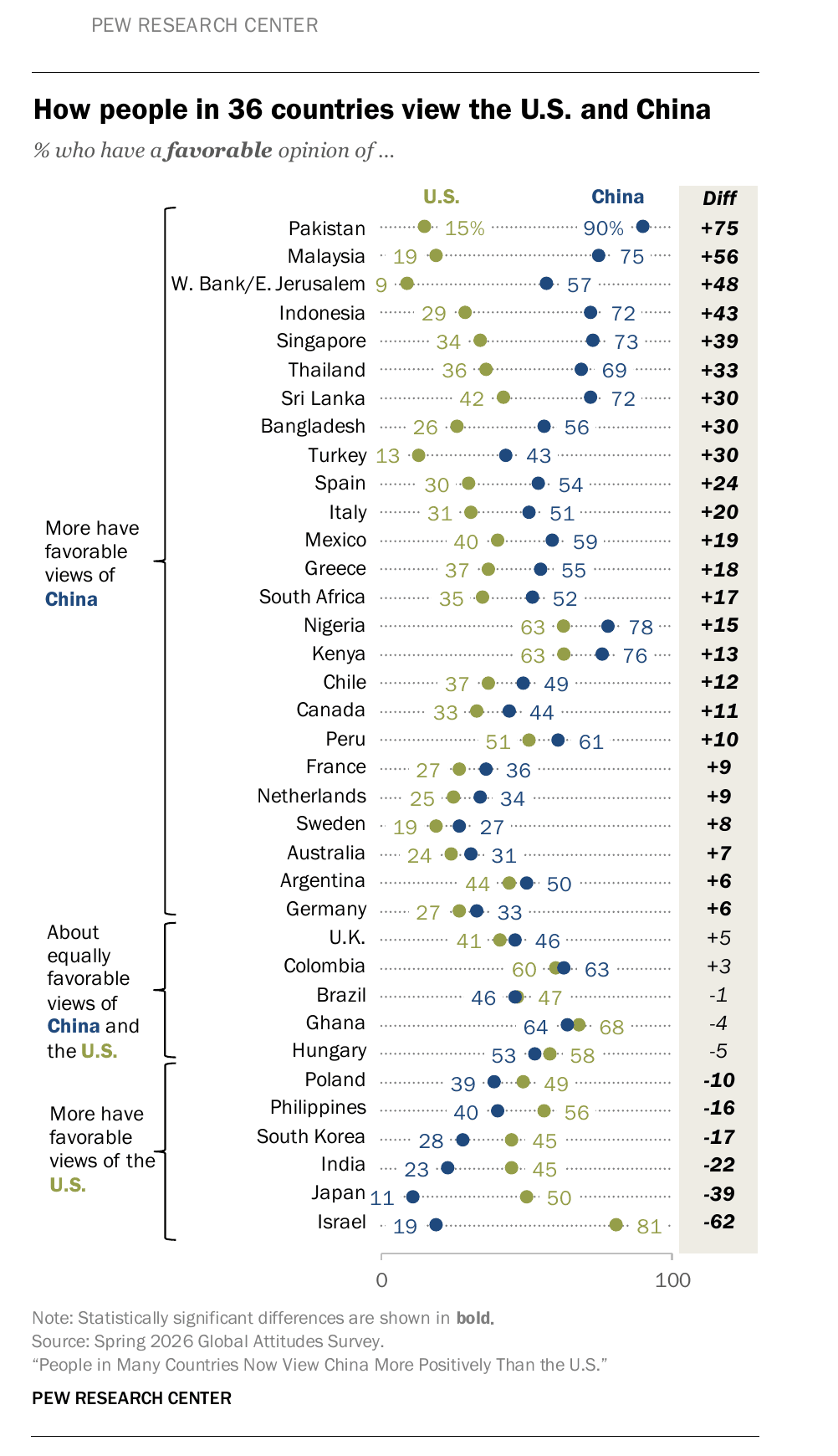
The table above reproduces Pew's Spring 2026 Global Attitudes Survey dot plot, "How people in 36 countries view the U.S. and China", in full — favourability toward the US, toward China and the gap are all Pew's published values, checked line by line against the report PDF. Pew's own grouping: 25 countries view China significantly more favourably than the US, 6 (Poland, the Philippines, South Korea, India, Japan, Israel) significantly the other way, and the rest show no significant difference. The sample is 42,151 people, fielded 8 February to 13 May 2026.
The same chart's data, country by country, for search and citation:
| # | Country or territory | China minus US (points) |
|---|---|---|
| 1 | Pakistan | +75 |
| 2 | Malaysia | +56 |
| 3 | W. Bank/E. Jerusalem | +48 |
| 4 | Indonesia | +43 |
| 5 | Singapore | +39 |
| 6 | Thailand | +33 |
| 7 | Sri Lanka | +30 |
| 8 | Bangladesh | +30 |
| 9 | Turkey | +30 |
| 10 | Spain | +24 |
| 11 | Italy | +20 |
| 12 | Mexico | +19 |
| 13 | Greece | +18 |
| 14 | South Africa | +17 |
| 15 | Nigeria | +15 |
| 16 | Kenya | +13 |
| 17 | Chile | +12 |
| 18 | Canada | +11 |
| 19 | Peru | +10 |
| 20 | France | +9 |
| 21 | Netherlands | +9 |
| 22 | Sweden | +8 |
| 23 | Australia | +7 |
| 24 | Argentina | +6 |
| 25 | Germany | +6 |
| 26 | U.K. | +5 |
| 27 | Colombia | +3 |
| 28 | Brazil | -1 |
| 29 | Ghana | -4 |
| 30 | Hungary | -5 |
| 31 | Poland | -10 |
| 32 | Philippines | -16 |
| 33 | South Korea | -17 |
| 34 | India | -22 |
| 35 | Japan | -39 |
| 36 | Israel | -62 |
Pew's chart 2: how the gap reversed
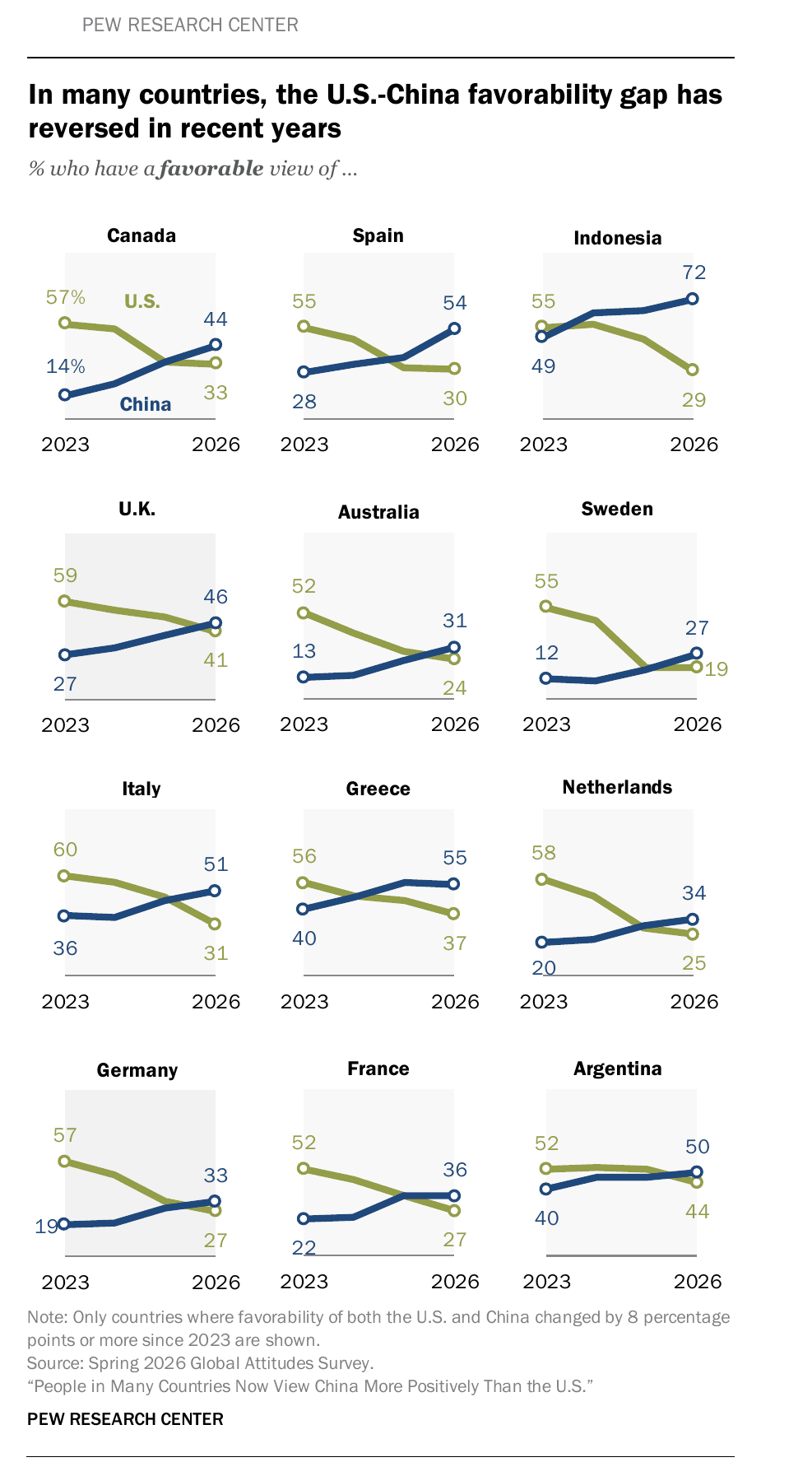
| # | Country | Favourable toward China, 2026 |
|---|---|---|
| 1 | Canada | 44% |
| 2 | Spain | 54% |
| 3 | Indonesia | 72% |
| 4 | U.K. | 46% |
| 5 | Australia | 31% |
| 6 | Sweden | 27% |
| 7 | Italy | 51% |
| 8 | Greece | 55% |
| 9 | Netherlands | 34% |
| 10 | Germany | 33% |
| 11 | France | 36% |
| 12 | Argentina | 50% |
How the Canadian lines crossed:
2023
2026
Pew's own formulation in the report is that improving views of China run in parallel with worsening views of the United States; CFR's reading leans toward the latter. Pew also states that the gap between views of China and the US is "especially large in many countries in the Asia-Pacific and the Middle East", and that of the 6 countries still leaning toward the United States, 4 are in the Asia-Pacific — India, Japan, the Philippines and South Korea.
A different yardstick: how each country feels about AI itself
The 2026 Microsoft-Gallup AI Adoption Survey (37 countries, around 1000 respondents each, fielded April to July) measures something else: how people in each country see AI itself, which is not the same yardstick as favourability toward China above. 93% of Chinese respondents believe AI will mainly benefit people in their own country, first of the 37 countries (followed by Vietnam, Singapore, Israel and Nigeria); the United States is at 36%, in the bottom five alongside Bangladesh (34%), Egypt (35%), Malawi (35%) and Afghanistan (37%) — the only developed economy on that list.
Share who believe AI will mainly benefit people in their own country
China is the most optimistic social environment for AI in the world, and that is the domestic floor under the technical-respect narrative. For a brand going abroad there are two emotional variables to handle rather than one: not only the target market's attitude toward China, but its attitude toward AI itself. American society's general pessimism about AI means an AI product narrative faces a natural headwind in the US market, regardless of the brand's nationality (inference).
Reddit's own reaction to the survey says something too: a repost on r/singularity on 24 September took 545 points and 427 comments — the comparison of Chinese and American feeling about AI is already material overseas communities will discuss repeatedly (a single post, cited only as evidence of the phenomenon).
The surveys record what people say when asked. What follows is what they talk about unprompted.
2. What overseas communities actually discuss: Chinese AI is talked about more, and more positively
KeepReal continuously monitors China-related discussion on Reddit (for how the corpus is defined, see the RIMC corpus). Reddit's users are mainly in North America and Europe — exactly the markets where the surveys show lower favourability toward China, and exactly the markets a high-ticket brand most wants to enter. In that hardest of examination rooms, the data on Chinese AI discussion has climbed three steps:
Step one: attention changed order of magnitude, and spread from a point into a fan. In January 2025, the month DeepSeek R1 was released, total monthly engagement for the Chinese AI category jumped from 98,000 the previous month to 1.2 million, roughly 12 times (monthly posts 227→578). What matters more is the structure that followed: the number of Chinese AI brands with more than a hundred posts in a month was 0 in December 2024 and 7 in September 2026 (those above 30 posts went from 3 to 9) — attention moved from one model's moment to a category's everyday.
Step two: the concentration of positives broke through its historical ceiling. The March full report judged that the positive share of Chinese AI discussion had long run in a band of 20–26% (neutral news reposts making up seven tenths is a structural property of Reddit's technology communities). In 2026 that ceiling broke: 45.2% positive in June and 44.6% in August (monthly samples n=535 and 2581). In September's high-engagement layer, net sentiment strengthened across Alibaba, DeepSeek, MiniMax and ByteDance AI (see China AI in September). Tool and creator communities carry an additional sentiment premium on top — a model that actually gets used runs 7 to 17 points higher on net sentiment in those communities than elsewhere (five months, n=3622; see Open weights as a distribution strategy).
Step three: contention thickened in step. The negative share rose from 2.9% in 2024 to 9.1% in 2026, reaching 16.5% in September under the impact of the Anthropic allegations. This is the other half the favourability narrative has to carry: the larger the scale of attention, the more both ends amplify at once — that same March report found the same rule in January 2025's data, where enthusiasm and data-security doubts erupted together and net sentiment was not the year's highest.
3. What this means for a brand going abroad
Other observations on the same definition: BYD's overseas reputation and China AI in September; the data comes from the RIMC corpus.
The change is concentrated in the technical layer. The most certain part of the change sits in the layer of technical respect: among technical people, developers and creators, both the assessment of Chinese models and the behaviour of using them have genuinely improved. That layer happens to be the first entry point to loosen inside the wealthy markets where the surveys are most pessimistic — favourability toward the product arrived before favourability toward the country, in the hardest markets (inference, from step two and the tool-community premium).
The exception route: win the professionals first, then talk about the public. For most brands going abroad, national image weighs heaviest on mass consumer decisions, while the data shows the first loosening in professionals' choice of tools. The implication is about sequence: technical and professional communities are the leading entry point into wealthy markets right now — build reputation first where things are verifiable and the trust barrier is low (open source, tools, professional content), then spill over into the mass setting (inference). The RIMC open-source piece gave the operating detail for that path: release cadence and something to get hands on matter more than volume.
The rule that has not changed: trust is earned brand by brand. An improvement in national favourability does not convert automatically into brand trust — September's KIMI is the fresh example: once an industry allegation hit product trust, it took the month's largest sentiment drop in the field, while Alibaba and DeepSeek, whose product narratives are solid, saw net sentiment rise rather than fall during the same allegation period. The mechanism by which a mistake is amplified has not disappeared; what has changed is the noise floor: a brand in 2026 has room for a product narrative to offset a negative, and Temu in 2022, newly arrived abroad, did not. Crisis management therefore needs a different yardstick — grade by whether product trust is shaken, not by how loud it is (inference; see the RIMC September analysis).
To close in one line: the turn across 2025 and 2026 is real and measurable, but what turned is often misstated. Only one thing genuinely turned — for the first time, technical respect is an asset Chinese brands can actively draw on; the overall attitude of overseas mass markets is nowhere near turning to welcome. An asset does not compound on its own, and it pays interest to two kinds of brand only: those that keep feeding verifiable product, and those that do not make mistakes on trust.
Source links
- Pew: People in Many Countries Now View China More Positively Than the U.S. (2026-07-15)
- Pew: Americans' views of China (2026-04-14)
- CFR: China Now Outranks the United States in Global Favorability
- bne IntelliNews on the 2026 Democracy Perception Index
- OfficeChai on the Microsoft-Gallup AI Adoption Survey · Traictory's reading
- RIMC: the September dual-line analysis, and the open-source and local-deployment piece
FAQ
What does national image mean for a brand going abroad? It is unremarkable in normal times, but the moment a brand slips it decides how far that mistake is amplified. Temu's low prices were forgotten quickly, while a “cheap and nasty” label, once it sticks, is amplified again and again.
Are the international surveys really turning? Yes, and it is verified. Pew's 36-country survey of July 2026 shows most countries now view China more favourably than the United States, with only 6 significantly the other way; Canadian favourability toward the US fell from 57% in 2023 to 33% while favourability toward China rose from 14% to 44%. In the United States itself, Pew's April 2026 reading puts 27% of Americans favourable toward China, up 6 points on the year.
What is the most practical implication of these changes for a brand going abroad? For the first time, technical respect is an asset Chinese brands can actively draw on — but it is established only in the technical and professional layer. Build reputation first where things are verifiable and the trust barrier is low (open source, tools, professional content), then spill over into the mass setting. The overall attitude of overseas mass markets is nowhere near turning to welcome.
Originally published 2026-10-04
Keep reading
Research
Product research | The AI video opportunity on Reddit
2026-11-09
Research
Product research | The X growth tools category: where the opportunity is after the scheduler
2026-11-09
Research
Product research | The 2026 overseas growth tool map: who does what in five categories, and what nobody does
2026-11-09
Turn overseas community reputation into a growth signal.
KeepReal tracks real discussion on Reddit and X so you show up in the right conversations.